<?xml version="1.0" encoding="utf-8"?><feed xmlns="http://www.w3.org/2005/Atom" ><generator uri="https://jekyllrb.com/" version="3.10.0">Jekyll</generator><link href="https://globam.science/feed.xml" rel="self" type="application/atom+xml" /><link href="https://globam.science/" rel="alternate" type="text/html" /><updated>2026-05-19T07:27:51+00:00</updated><id>https://globam.science/feed.xml</id><title type="html">GloBAM</title><subtitle>GloBAM project website</subtitle><author><name>GloBAM partners</name></author><entry><title type="html">Millions of birds lose precious energy due to fireworks on New Year’s Eve</title><link href="https://globam.science/news/2023/paper-fireworks/" rel="alternate" type="text/html" title="Millions of birds lose precious energy due to fireworks on New Year’s Eve" /><published>2023-12-18T00:00:00+00:00</published><updated>2023-12-18T00:00:00+00:00</updated><id>https://globam.science/news/2023/paper-fireworks</id><content type="html" xml:base="https://globam.science/news/2023/paper-fireworks/"><![CDATA[<p>Birds are affected by the mass use of fireworks on New Year’s Eve up to a distance of 10 km away. With data from weather radars and bird counts an international team of researchers revealed how many birds take off immediately after the start of the fireworks, at what distance from fireworks this occurs and which species groups mainly react. ‘We already knew that many water birds react strongly, but now we also see the effect on other birds throughout the Netherlands’, says ecologist Bart Hoekstra of the University of Amsterdam. In the scientific journal <a href="https://doi.org/10.1002/fee.2694">Frontiers in Ecology and the Environment</a>, the researchers therefore argue for large fireworks-free zones.</p>

<div class="ratio ratio-4x3 mb-3">
  <iframe src="https://player.vimeo.com/video/887618127" frameborder="0" allowfullscreen=""></iframe>
</div>

<p>On New Year’s Eve, an average of 1,000 times as many birds are in the air close to where fireworks are set off as on other nights, with peaks of 10,000 to 100,000 times the normal number of birds. The effects are strongest within the first 5 km of fireworks, but up to 10 km there are still an average of at least 10 times as many birds flying as normal.</p>

<p>‘Birds take off as a result of an acute flight response due to sudden noise and light. In a country like the Netherlands, with many wintering birds, we are talking about millions of birds being affected by the lighting of fireworks,’ says Hoekstra.
Weather radar and bird counts</p>

<p>Last year, other researchers at IBED discovered that geese are so affected by fireworks that they spend an average of 10% longer looking for food than normal during at least the next 11 days. They apparently need that time to replenish the lost energy or to compensate for the unknown foraging area in which they have ended up, after fleeing from the fireworks.</p>

<p>Hoekstra’s study looked at which species take off after fireworks and when this occurs. He used information from Royal Netherlands Meteorological Institute weather radars during both a clear New Year’s Eve and on other normal nights. He combined this with distribution data from Sovon – the Dutch Centre for Field Ornithology – based on bird counts by hundreds of volunteers. ‘We already knew that many water birds react strongly, but it was still unclear how birds outside these waterbodies react to fireworks. Through the counts we know exactly where which birds are and using the radar images we can see where they actually take off because of fireworks.’ Using the data, Hoekstra was able to calculate how many birds take off immediately after the start of the fireworks, at what distance from fireworks this happens, and which species groups mainly react.</p>

<p>The analysis makes it clear that in the study areas around the radars in Den Helder and Herwijnen alone, almost 400,000 birds take off immediately at the start of the fireworks during New Year’s Eve. Moreover, it appears that larger birds in open areas in particular fly around for hours after and at remarkable altitudes. Hoekstra: ‘Larger birds such as geese, ducks and gulls fly to a height of hundreds of metres due to the large-scale discharge of fireworks and remain in the air for up to an hour. There is a risk that they will end up in bad winter weather, or that they will not know where they are flying due to panic and accidents could occur.’</p>

<p>Because 62% of all birds in the Netherlands live within a radius of 2.5 km of inhabited areas, the consequences of fireworks are high for all birds throughout the country. ‘Flying requires a lot of energy, so ideally birds should be disturbed as little as possible during the cold winter months. Measures to ensure this are especially important in open areas such as grasslands, where many larger birds spend the winter. The effects of fireworks on birds are less pronounced near forests and semi-open habitats. In addition, smaller birds such as tits and finches live there, which are less likely to fly away from disturbance.’</p>

<p>The authors argue for fireworks-free zones in areas where large birds live. Hoekstra: ‘These buffer zones could be smaller in areas where light and sound travel less far, such as near forests. Furthermore, fireworks should mainly be lit at central locations in built-up areas, as far away from birds as possible. It would be best for birds if we moved towards light shows without sound, such as drone shows or decorative fireworks without very loud bangs.’</p>

<p><a href="https://www.uva.nl/en/content/news/news/2023/12/millions-of-birds-lose-precious-energy-due-to-fireworks-on-new-years-eve.html">Original press release</a></p>]]></content><author><name>Bart Kranstauber</name></author><category term="paper" /><summary type="html"><![CDATA[Birds are affected by the mass use of fireworks on New Year's Eve up to a distance of 10 km away.]]></summary></entry><entry><title type="html">Paper out on the nightly timing of migration</title><link href="https://globam.science/news/2023/paper-phenology/" rel="alternate" type="text/html" title="Paper out on the nightly timing of migration" /><published>2023-08-21T00:00:00+00:00</published><updated>2023-08-21T00:00:00+00:00</updated><id>https://globam.science/news/2023/paper-phenology</id><content type="html" xml:base="https://globam.science/news/2023/paper-phenology/"><![CDATA[<p>During spring and fall billions of birds migrate through the night. It is widely recognized most nocturnal migrants start migrating around sunset. However, the timing of migration throughout the night has been studied less frequently. In <a href="https://doi.org/10.1111/geb.13742">Kranstauber at al. (2023)</a>, we analyze 3051 nights where migration was observed across 55 different weather radars in Europe. We find that most variation in the timing of migration throughout the night can be explained by an univariate axis.</p>

<p>In spring migration is generally evenly spread throughout the night compared to fall, furthermore closer to the coast migration is more concentrated at the beginning of the night. At these locations, birds either embark on sea crossings early in the night or continue migration one more days after a sea crossing at night fall. Understanding these patterns helps to optimize conservation and mitigation measures.</p>]]></content><author><name>Bart Kranstauber</name></author><category term="paper" /><summary type="html"><![CDATA[Geographic barriers and season shape the nightly timing of avian migration.]]></summary></entry><entry><title type="html">GloBAM wins Biodiversa Prize for Excellence and Impact</title><link href="https://globam.science/news/2023/biodiversa-prize/" rel="alternate" type="text/html" title="GloBAM wins Biodiversa Prize for Excellence and Impact" /><published>2023-07-06T00:00:00+00:00</published><updated>2023-07-06T00:00:00+00:00</updated><id>https://globam.science/news/2023/biodiversa-prize</id><content type="html" xml:base="https://globam.science/news/2023/biodiversa-prize/"><![CDATA[<p>We are very honoured to have received the <a href="https://www.biodiversa.eu/2023/07/06/biodiversa-prize-for-excellence-and-impact-2-new-videos/">Biodiversa Prize for Excellence and Impact</a>, together with the AlienScenarios project.</p>

<p>Biodiversa+ has developed an animated video with us and the animation studio Squarefish to highlight our findings and to disseminate our work with the scientific community and beyond. Watch the video below.</p>

<div class="ratio ratio-16x9">
<iframe src="https://www.youtube.com/embed/BjQQeXGvYc4" title="YouTube video player" frameborder="0" allow="accelerometer; autoplay; clipboard-write; encrypted-media; gyroscope; picture-in-picture; web-share" allowfullscreen=""></iframe>
</div>]]></content><author><name>Peter Desmet</name></author><category term="prize" /><summary type="html"><![CDATA[We are very honoured to have received the Biodiversa Prize for Excellence and Impact, together with the AlienScenarios project.]]></summary></entry><entry><title type="html">starsTileServer visualizes large spatial data sets</title><link href="https://globam.science/news/2022/starstileserver/" rel="alternate" type="text/html" title="starsTileServer visualizes large spatial data sets" /><published>2022-01-21T00:00:00+00:00</published><updated>2022-01-21T00:00:00+00:00</updated><id>https://globam.science/news/2022/starsTileServer</id><content type="html" xml:base="https://globam.science/news/2022/starstileserver/"><![CDATA[<p>New technologies were needed to address the challenge of visualizing large archives of weather radar data and bird specific products interactively. The goal of the R package <a href="https://cran.r-project.org/web/packages/starsTileServer/index.html">starsTileServer</a> is to provide a simple way to add large data sets to a leaflet or shiny application.</p>

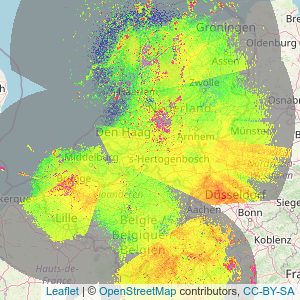
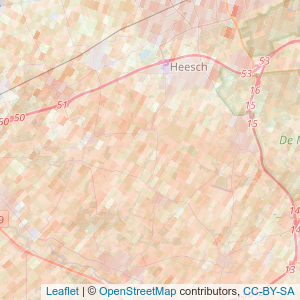
<p><img src="/assets/images/2022-01-21-starsTileServer.png" alt="img" class="d-inline w-50" /><img src="/assets/images/2022-01-21-starsTileServer_2.png" alt="img" class="d-inline w-50" />
<em>Example visualizing birds and velocities from meteorological radar data</em></p>
<p>Although the need arose from visualizing radar data the application is more general. Because it is possible to provide custom functions pretty much any data that can be projected, can be visualized, including composites or non square grids.</p>

<p>More examples are available on the <a href="https://bartk.gitlab.io/starsTileServer/">website</a>. The website also shows how applications can be made scalable. Using this it is possible to generate the images needed for longer animations like this one:</p>

<blockquote class="twitter-tweet" data-conversation="none" data-dnt="true"><p lang="en" dir="ltr">Now also with video <a href="https://t.co/CwzEHtAS5F">pic.twitter.com/CwzEHtAS5F</a></p>&mdash; Bart Kranstauber (@bart_kra) <a href="https://twitter.com/bart_kra/status/1463560977144856582?ref_src=twsrc%5Etfw">November 24, 2021</a></blockquote>
<script async="" src="https://platform.twitter.com/widgets.js" charset="utf-8"></script>]]></content><author><name>Bart Kranstauber</name></author><category term="software" /><summary type="html"><![CDATA[Making large spatial data sets accessible for dynamic visualization is challenging, starsTileServer facilitates this.]]></summary></entry><entry><title type="html">Benefits of using non-checklist bird portal data</title><link href="https://globam.science/news/2021/paper-non-checklist-data/" rel="alternate" type="text/html" title="Benefits of using non-checklist bird portal data" /><published>2021-04-08T00:00:00+00:00</published><updated>2021-04-08T00:00:00+00:00</updated><id>https://globam.science/news/2021/paper-non-checklist-data</id><content type="html" xml:base="https://globam.science/news/2021/paper-non-checklist-data/"><![CDATA[<p>Millions of bird observations have been entered on online bird portals in the past 20 years, such as the first in the portal history, the Swedish Artportalen, or the Finnish Tiira, the Swiss Ornitho and its European siblings. This wealth of observations - available either as checklists or arbitrary individual entries - could be potentially used for scientific research about avifaunal dynamics, as a complement to traditional monitoring programs through bird surveys and ringing by volunteers and scientists. While several hundred publications have been written on a variety of topics based on eBird checklists worldwide, unstructured non-checklist observations, which represent the vast majority of European bird observations, have received little attention and praise by academia.</p>

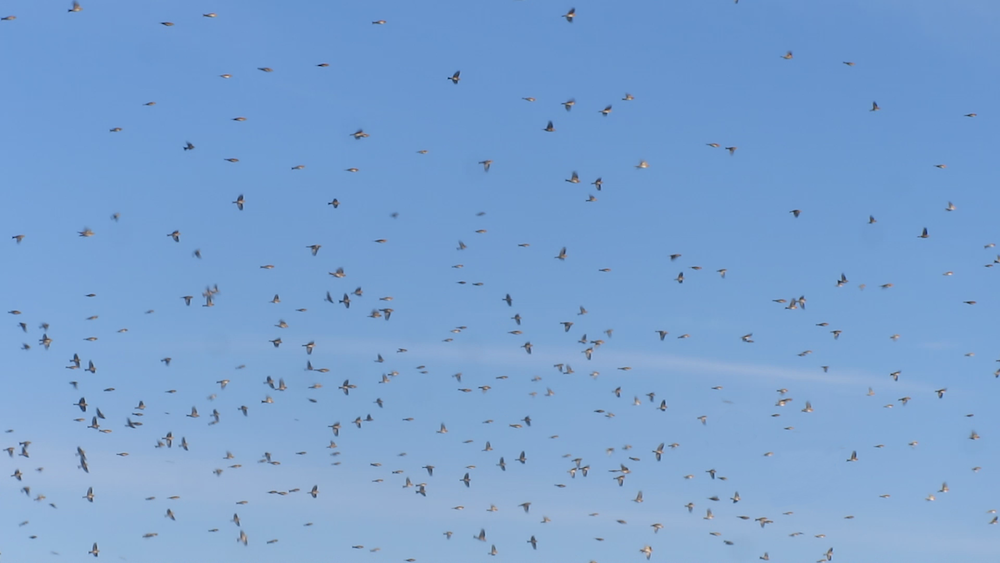
<p><img src="/assets/images/2021-04-08-paper-non-checklist-data-bramblings.png" alt="Flock of bramblings" />
<em>Figure 1. Flocks of diurnal migrants are easily observed by field ornithologists aka citizen scientists, like this flock of about 4000 bramblings Fringilla montifringilla in Southern Finland in October 2020 (Source: Nadja Weisshaupt).</em></p>
<p>In the paper <a href="https://doi.org/10.1371/journal.pone.0246572">Weisshaupt et al. (2021)</a>, we analysed 10 years of ornithological non-checklist data including over 400 million individuals of 115 bird species to obtain migration phenologies, i.e. start, peak and end of spring and autumn migration, and we discuss challenges and benefits of non-checklist data, amongst others in comparison to checklist data approaches. Overall, non-checklist data proved to be well suited to determine descriptors of migration phenology in Northern Europe which are challenging to attain by any other currently available means. The methodology is flexible and easily applicable also to non-checklist data from other bird portals.</p>

<p>The unprecedented spatiotemporal coverage makes non-checklist data a valuable complement to current migration databases from bird observatories. It could be used in climate change studies or in combination with radar data to relieve the species identification problem in aeroecology (<a href="https://doi.org/10.1111/ibi.12906">Weisshaupt et al. 2020</a>).</p>]]></content><author><name>Nadja Weisshaupt</name></author><category term="paper" /><summary type="html"><![CDATA[Non-checklist data from ornithological citizen science portals provide unprecedented insights into bird migration phenologies.]]></summary></entry><entry><title type="html">CROW: A new tool to watch bird migration in real time</title><link href="https://globam.science/news/2021/crow/" rel="alternate" type="text/html" title="CROW: A new tool to watch bird migration in real time" /><published>2021-03-26T00:00:00+00:00</published><updated>2021-03-26T00:00:00+00:00</updated><id>https://globam.science/news/2021/crow</id><content type="html" xml:base="https://globam.science/news/2021/crow/"><![CDATA[<p class="alert alert-info">This post originally appeared on the <a href="https://oscibio.inbo.be/blog/crow/">Open science lab for biodiversity blog</a> and is republished here with permission. The development of CROW was not funded under GloBAM, but the tool will likely be used and extended for GloBAM.</p>

<p>Every spring and autumn, millions of birds migrate over our country. They mainly do this at high altitudes and at night, making this phenomenon largely invisible to us. But not for weather radars!</p>

<p>Today the <a href="https://oscibio.inbo.be">Open science lab for biodiversity</a> at the INBO and the Royal Meteorological Institute of Belgium (<a href="https://www.meteo.be/">RMI</a>) are launching a <a href="http://www.meteo.be/birddetection"><strong>web application</strong></a> allowing anyone to view this migration in real time across the Benelux. It shows that bird migration started exceptionally early this year, caused by the unusually warm weather in the second half of February. The development of the website was co-supervised by the Royal Belgian Institute of Natural Sciences (<a href="https://www.naturalsciences.be/">RBINS</a>) and financially supported by the <a href="https://www.belspo.be/">Federal Science Policy</a> (BelSPO valorisation project CROW).</p>

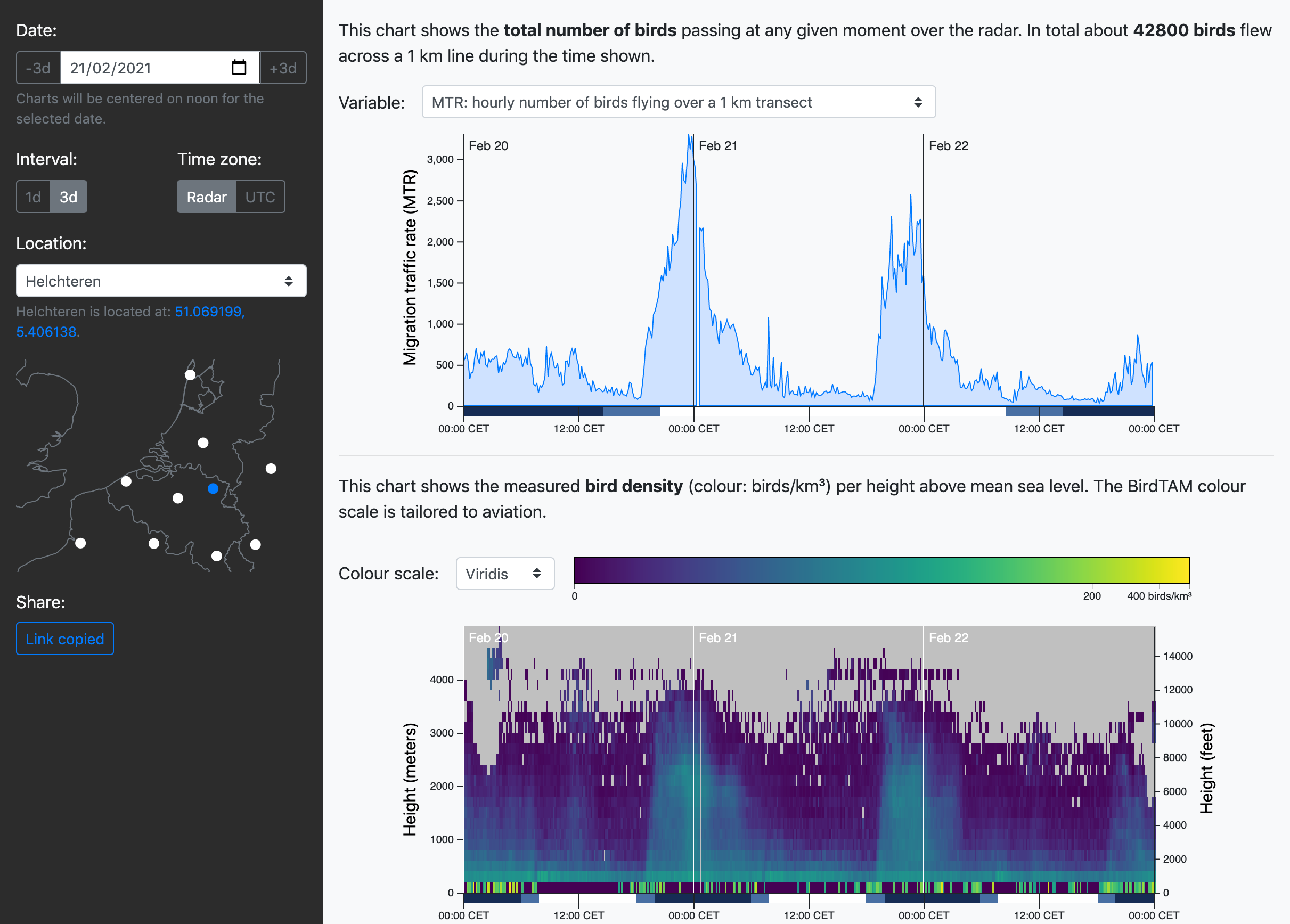
<p><a href="http://www.meteo.be/birddetection"><img src="/assets/images/2021-03-26-crow-screenshot.png" alt="" /></a>
<em>The new web application, showing the Helchteren radar for a three days period around February 21, 2021. Due to the exceptionally warm weather during that period, spring migration started earlier than normal. From the figure it is also clear that the most intense migration always takes place in the first half of the night. The birds reach heights of up to three kilometers (and sometimes even more).</em></p>

<p>What does meteorology have to do with bird migration? A lot, it turns out, and in both directions. Birds wait for the ideal weather conditions to start their long journey to their wintering grounds in the south and back to their breeding grounds in the other direction. But equally intriguing is the fact that one of the most important measuring instruments in meteorology today, the <strong>weather radar</strong>, can measure this migration in detail. Indeed: weather radars do not only detect water droplets in the atmosphere, but also birds moving through the air.</p>

<p>The <a href="http://www.meteo.be/birddetection">website</a> launched today offers a unique overview of bird migration across the Benelux, based on <strong>ten weather radars</strong> located in Belgium, the Netherlands, France and Germany. The graph that is shown first when loading the website is the so-called “MTR” (Migration Traffic Rate). This parameter expresses the number of birds that pass through the vicinity of the radar at a given moment, through an imaginary screen that is 1 km wide and “infinitely” high (in practice, 5 km is taken as maximum height). It can be compared with the “stream” or the “flux” of birds that “flows” through the air.</p>

<p>The colourful figure underneath shows how these birds are distributed across the vertical layers of the atmosphere. The parameter shown in this figure is the bird density, expressed as the number of birds per cubic kilometer. However, certain assumptions have to be made to arrive at this number (e.g. about the typical size of a migratory bird). It also excludes bird movements close to the ground, as radars are not able to detect those. More explanation about the correct interpretation is provided on the website itself.</p>

<p>As usual for our team, we developed this tool as <a href="https://github.com/inbo/crow">open source software</a>. We hope to extend it to visualize even more open bird migration data for the <a href="https://globam.science">GloBAM project</a>.</p>

<ul>
  <li><a href="https://www.vlaanderen.be/inbo/persberichten/tien-weerradars-detecteren-vogeltrek-over-de-benelux-en-jij-kan-meekijken">INBO press release (in Dutch)</a></li>
  <li><a href="https://youtu.be/uwvXKmOViws">Short video on radar aeroecology</a></li>
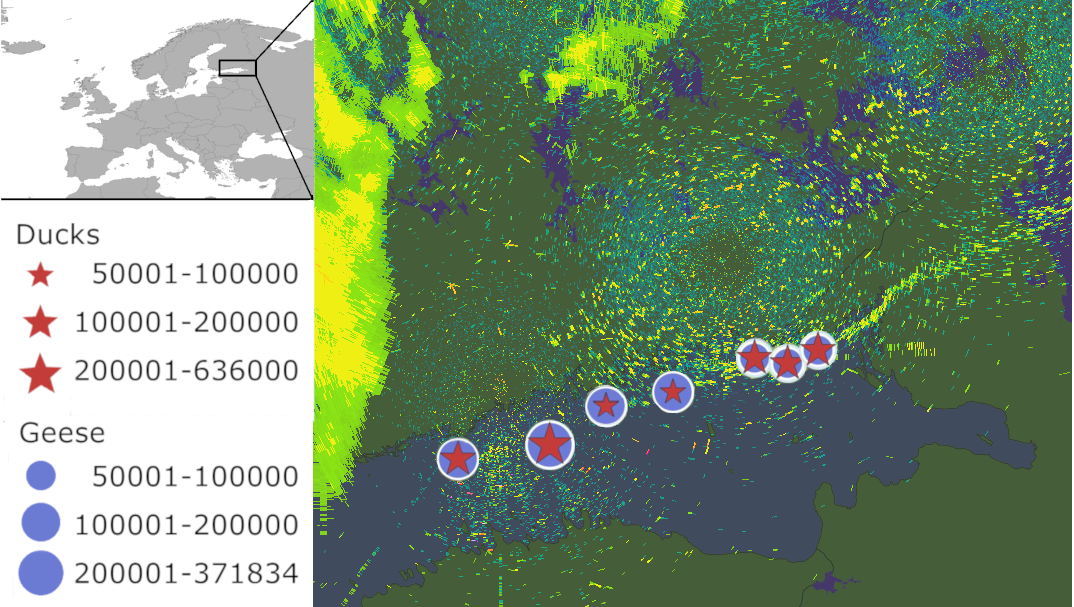
</ul>]]></content><author><name>Peter Desmet, Maarten Reyniers, Robin Brabant</name></author><category term="software" /><summary type="html"><![CDATA[A GloBAM partner launched an interactive visualization to follow bird migration detected by weather radars across the Benelux.]]></summary></entry><entry><title type="html">Synergies of citizen science and weather radars</title><link href="https://globam.science/news/2020/paper-citizen-science-and-radar/" rel="alternate" type="text/html" title="Synergies of citizen science and weather radars" /><published>2020-11-24T00:00:00+00:00</published><updated>2020-11-24T00:00:00+00:00</updated><id>https://globam.science/news/2020/paper-citizen-science-and-radar</id><content type="html" xml:base="https://globam.science/news/2020/paper-citizen-science-and-radar/"><![CDATA[<p>Networks of weather radars are increasingly used to study bird migration fluxes. They potentially provide insights into how birds react to ecological barriers and weather events at large scales and how human infrastructure and land use may affect the birds’ lives. Large-scale species-specific solutions are increasingly needed to support risk mitigation and conservation actions along migration corridors at appropriate scales. In this context, weather radars (WR) have incited the interest of biologists in recent decades, given the worldwide distribution of these radars in large networks with overall about 1000 radars. They represent a unique opportunity to study simultaneously and continuously regional to continent-wide dynamics of aerofauna and to address concerns related to increasing human-wildlife conflicts in the air. There is just one major downside: weather radars do not recognize species. Tools for the spatio-temporal validation of faunistic interpretations of weather radar measurements in situ are only sparsely available. Citizen science bird observation repositories established in the past 20 years have accumulated hundreds of millions of entries of species-specific information across vast areas. Together with other citizen science data sources, these databases can relieve the taxonomic shortcomings of WRs and thus extend and refine the use of WR data. An example is presented in Figure 1.</p>

<p><img src="/assets/images/2020-11-24-paper-citizen-science-and-radar-arctic-waterfowl.png" alt="Arctic waterfowl migration in the Gulf of Finland as depicted by weather radars" />
<em>Figure 1. Arctic waterfowl migration in the Gulf of Finland as depicted by weather radars on 17 May 2017 and locations of bird observations reported on the Finnish bird portal Tiira.</em></p>
<p>In the Forum paper <a href="https://doi.org/10.1111/ibi.12906">Weisshaupt et al. (2020)</a>, we present features and qualities of ornithological citizen science and weather radar data, and their potential to study regional to continent-wide aerial movements of birds. The paper discusses specific fields of applications where maximum information yield is to be expected, recent developments in weather radar data analysis, and in which way combined approaches would support biological research and derived data products and services for stakeholders e.g. in aviation, the environmental sector, meteorological service providers and the general public as beneficiaries.</p>]]></content><author><name>Nadja Weisshaupt</name></author><category term="paper" /><summary type="html"><![CDATA[How citizen science and weather radar data can complement each other to provide novel insights into bird migration fluxes at various spatio-temporal scales]]></summary></entry><entry><title type="html">Paper out on bat migration ecology</title><link href="https://globam.science/news/2020/paper-brackencave-phenology/" rel="alternate" type="text/html" title="Paper out on bat migration ecology" /><published>2020-11-05T00:00:00+00:00</published><updated>2020-11-05T00:00:00+00:00</updated><id>https://globam.science/news/2020/paper-brackencave-phenology</id><content type="html" xml:base="https://globam.science/news/2020/paper-brackencave-phenology/"><![CDATA[<p>Climate (change) has been repeatedly shown to strongly affect when birds migrate. For other animal taxa such as bats and insects, knowledge on the effects of climate (change) on their migration phenology remains rather limited. Perhaps the biggest obstacle is the lack of long-term phenology datasets.</p>

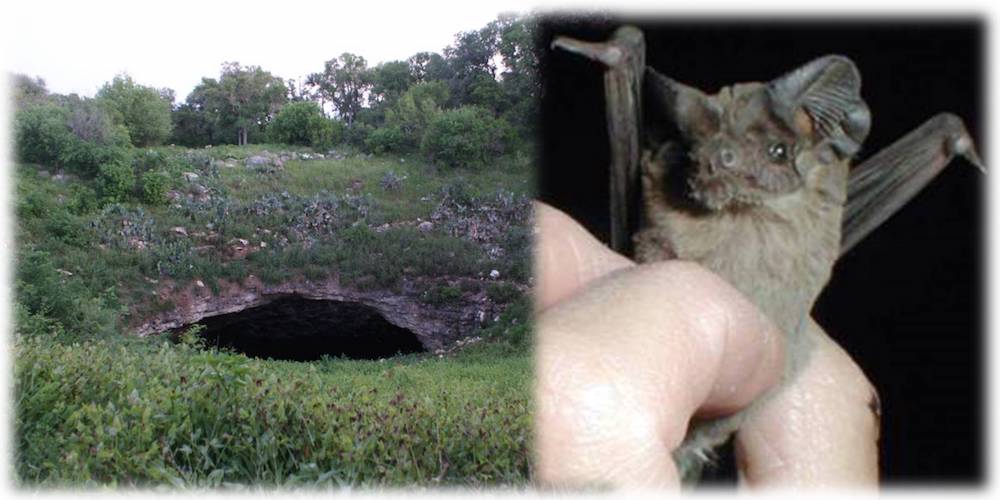
<p>Bracken Cave in Texas (USA) holds one of the largest bat colonies in the world. Using weather radar data, a unique 23-year (1995-2017) long time series was recently produced of the spring and autumn migration phenology of Brazilian free-tailed bats (<em>Tadarida brasiliensis</em>) at Bracken Cave (<a href="https://doi.org/10.1111/gcb.14051">Stepanian &amp; Wainwright, 2018</a>).</p>

<p><img src="/assets/images/2020-11-05-paper-brackencave-phenology-caveandbats.jpg" alt="Left: Bracken Cave in Texas, USA (Source: Daniel Spiess, CC BY-SA 2.0, via Wikimedia Commons); Right: Tadarida brasiliensis (Source: NPS, Public domain, via Wikimedia Commons)" />
<em><strong>Left</strong>: Bracken Cave in Texas, USA (Source: <a href="https://commons.wikimedia.org/wiki/File:Bracken_Cave_Bats.jpg">Daniel Spiess</a>, <a href="https://creativecommons.org/licenses/by-sa/2.0">CC BY-SA 2.0</a>, via Wikimedia Commons); <strong>Right</strong>: Tadarida brasiliensis (Source: <a href="https://commons.wikimedia.org/wiki/File:Tadarida_brasiliensis.jpg">NPS</a>, Public domain, via Wikimedia Commons)</em></p>

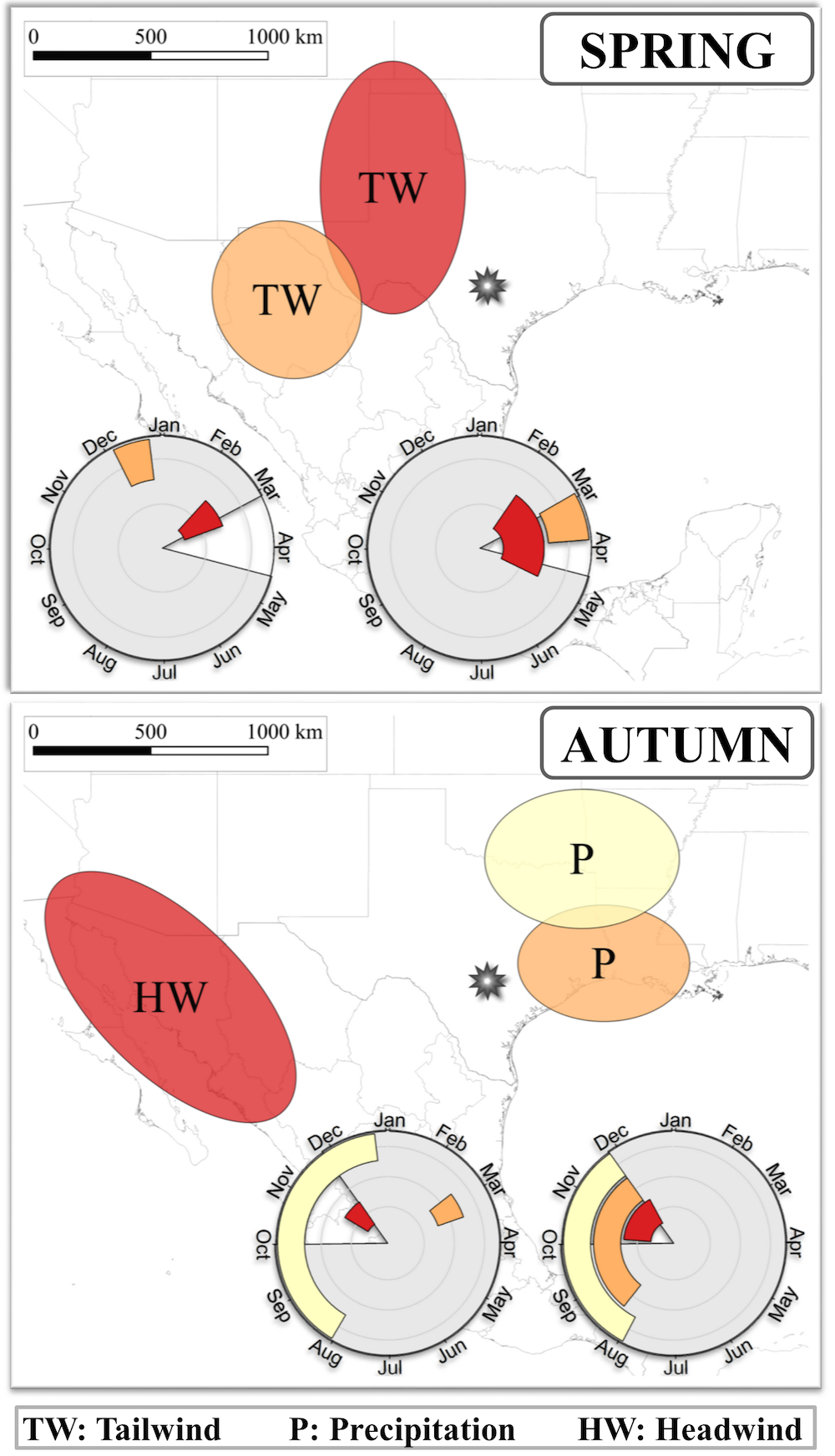
<p>In <a href="https://doi.org/10.1111/gcb.15433">Haest et al. (accepted - available online)</a>, we now analysed these migration phenology time series in combination with gridded temperature, precipitation, and wind data across Mexico and southern USA, to identify the climatic drivers of (changes in) bat migration phenology. Perhaps surprisingly, our extensive spatiotemporal search did not find temperature to influence either spring or autumn migration. Instead, spring migration phenology seems to be predominantly driven by wind conditions at likely wintering or spring stopover areas during the migration period. Autumn migration phenology on the other hand, seems to be dominated by precipitation to the east and north-east of Bracken Cave. Long-term changes towards more frequent migration-favourable wind conditions have, furthermore, allowed spring migration to occur 16 days earlier. Our results illustrate how some of the remaining knowledge gaps on the influence of climate (change) on bat migration and abundance can be addressed using weather radar analyses.</p>

<p><img src="/assets/images/2020-11-05-paper-brackencave-phenology-resultsmap.jpg" alt="Location and timing of the identified most important weather variables that are likely to influence spring and autumn migration timing at Bracken Cave. The timelines in each plot represent the period of the single best time window (left) and of the medians for the time window opening and closing of the 95% confidence interval of all time windows (right). P: precipitation; HW: headwind; TW: tailwind. The location of Bracken Cave is marked with a star. The white background triangles in the time window subfigures represent the migration period at Bracken Cave, i.e. the period between the earliest and latest estimated average migration time at Bracken Cave over the entire study period." />

<em>Location and timing of the identified most important weather variables that are likely to influence spring and autumn migration timing at Bracken Cave. The timelines in each plot represent the period of the single best time window (left) and of the medians for the time window opening and closing of the 95% confidence interval of all time windows (right). P: precipitation; HW: headwind; TW: tailwind. The location of Bracken Cave is marked with a star. The white background triangles in the time window subfigures represent the migration period at Bracken Cave, i.e. the period between the earliest and latest estimated average migration time at Bracken Cave over the entire study period.</em></p>

<p><a href="https://doi.org/10.1111/gcb.15433">Haest B, Stepanian P M, Wainwright C, Liechti F, Bauer S (accepted – available online). Climatic drivers of (changes in) bat migration phenology at Bracken Cave (USA). Global Change Biology</a>.</p>

<p>The paper was covered by <a href="https://www.independent.co.uk/author/daisy-dunne">Daisy Dunne</a> in the <em>Climate Change</em> section of the UK newspaper <a href="https://www.independent.co.uk/">The Independent</a>: <a href="https://www.independent.co.uk/environment/climate-change/bat-migration-climate-change-us-b1722435.html">“Climate crisis could be causing bats to migrate earlier, study says”</a>.</p>]]></content><author><name>Birgen Haest</name></author><category term="paper" /><summary type="html"><![CDATA[How does climate (change) affect the timing of bat migration at Bracken Cave (USA)?]]></summary></entry><entry><title type="html">Popular radar aeroecology papers</title><link href="https://globam.science/news/2020/popular-papers/" rel="alternate" type="text/html" title="Popular radar aeroecology papers" /><published>2020-05-04T00:00:00+00:00</published><updated>2020-05-04T00:00:00+00:00</updated><id>https://globam.science/news/2020/popular-papers</id><content type="html" xml:base="https://globam.science/news/2020/popular-papers/"><![CDATA[<p>Papers from the <strong>special issue on radar aeroecology</strong> was among the top 10% of most downloaded papers from the journal Ecography during 2018 and 2019. The special issue includes many GloBAM authors and covers everything from the history of radar aeroecology, to current methods used, implementations and future perspectives.</p>

<p>The whole special issue is open access and you can read it <a href="https://onlinelibrary.wiley.com/doi/toc/10.1111/(ISSN)1600-0587.radar-aeroecology">here</a>.</p>

<iframe width="100%" height="400" src="https://www.youtube.com/embed/uwvXKmOViws" frameborder="0" allow="accelerometer; autoplay; encrypted-media; gyroscope; picture-in-picture" allowfullscreen=""></iframe>]]></content><author><name>Cecilia Nilsson</name></author><category term="paper" /><summary type="html"><![CDATA[Our radar aeroecology papers are among most downloaded.]]></summary></entry><entry><title type="html">World Biodiversity Forum</title><link href="https://globam.science/news/2020/wbf-davos/" rel="alternate" type="text/html" title="World Biodiversity Forum" /><published>2020-02-27T00:00:00+00:00</published><updated>2020-02-27T00:00:00+00:00</updated><id>https://globam.science/news/2020/wbf-davos</id><content type="html" xml:base="https://globam.science/news/2020/wbf-davos/"><![CDATA[<p>A month after the World Economic Forum, the little town of Davos in the Eastern Swiss Alps hosted the <a href="https://www.worldbiodiversityforum.org/index.html">World Biodiversity Forum</a>.</p>

<p><img src="/assets/images/2020-02-27-wbf-davos-poster.jpg" alt="Davos Poster" /></p>

<p>It was organized primarily by the University of Zurich and particularly by its university research program <a href="https://www.gcb.uzh.ch/en.html">Global change and biodiversity</a>. The conference program clearly reflected the research focus of its organisers, i.e. current state of remote sensing and its potential future developments, see <a href="https://www.worldbiodiversityforum.org/de/sessions">session topics</a>.</p>

<p>Surprisingly few contributions had anything to do with animal movements and how that might shape biodiversity or be an integral part of biodiversity and if this WBF will be a conference series (I don’t know), it might be worth getting in touch with the organizers to have more on that in future conferences.</p>

<p>The conference ended with the adoption of the <a href="https://www.worldbiodiversityforum.org/de/davos-resolution">Davos resolution</a>.</p>

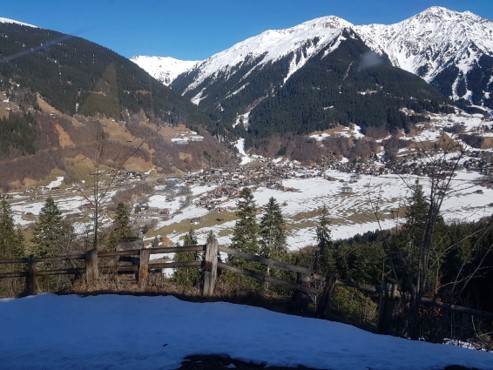
<p>Sidenote: Davos is situated almost 1600 m a.s.l., a traditional famous ski resort and home to Hockey Club Davos, its premier league ice hockey team. Despite the altitude and time of the year, there was surprisingly little snow and actually the first for me in this winter season!</p>

<p><img src="/assets/images/2020-02-27-wbf-davos-on-the-way.jpg" alt="On the way" /></p>]]></content><author><name>Silke Bauer</name></author><category term="meeting" /><summary type="html"><![CDATA[A brief summary of the WBF meeting Silke attended in Davos, Switzerland on 23-28 February 2020.]]></summary></entry></feed>